 0792-88989898
  ruya9898@163.com






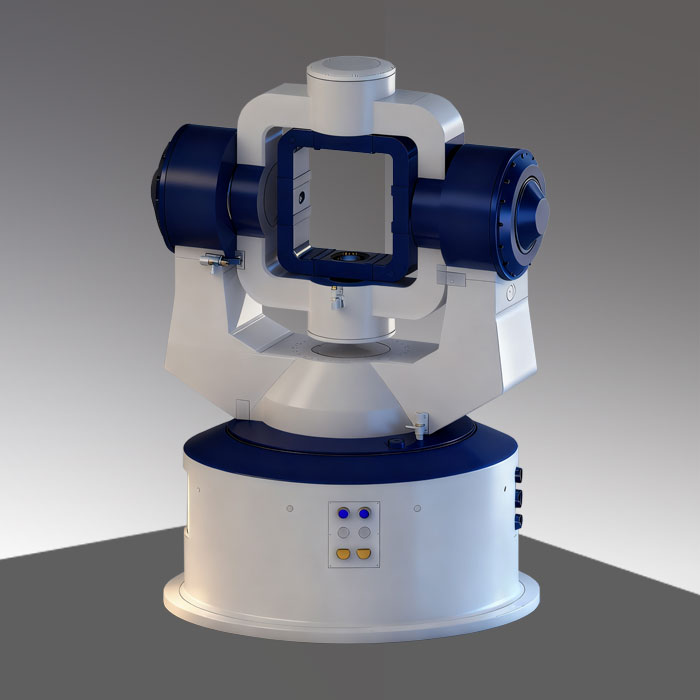
Dual-axis Electric Rotary Table
The three-axis simulation turntable consists of two main parts: a mechanical platform and a measurement and control system. The platform adopts a U-O-O structure, a precision mechanical axis system, and a high stiffness platform structure, and has functions such as simulation, position, velocity, and swing.
The three-axis simulation turntable is widely used in the fields of aviation, aerospace, navigation, and national defense. It can simulate the attitude movements of aircraft such as roll, pitch, and yaw in space, reproduce various dynamic characteristics during motion, and provide a near real motion environment for loads. Its high-precision motion simulation capability makes it an important tool for semi physical simulation and testing of guidance systems, control systems, and corresponding components of missiles, aircraft, drones, and other aircraft. Through repeated testing of system performance, sufficient experimental data is obtained, and the system is redesigned and improved based on the data to meet the performance requirements of the overall design of the aircraft.
The three-axis simulation turntable can also provide single axis, dual axis, or three-axis positioning and velocity reference for the tested load, used for testing and experimentation of inertial components, assemblies, and inertial navigation systems.
Maximum load: 35kg (including installation fixture);
Load size: 400mm × 400mm × 450mm;
Intersection degree of three axes: ± 0.3mm;
Three axis perpendicularity: ± 18 ″;
Installation surface accuracy: ≤± 2 ″; Positioning surface accuracy: ≤± 2 ″;
Installation surface magnetic leakage: ≤ 0.1mT (at a distance of 10mm from the installation surface);
Conductive slip ring: The user's ring should have no less than 80 rings;
The external dimensions of the mechanical platform are approximately 1600 in length, 1450 in width, and 2200mm in height;
Weight: Approximately 3000kg.
mainperformance metrics
Three-axis simulation turntable | |||
roll(Inner axis) | pitch(Inner axis) | heading | |
Corner range | 360°continuous | 360°continuous | 360°continuous |
maximum angular velocity | 400 o/s | 400 o/s | 300 o/s |
Maximum angular acceleration | 4000o/s2 | 2500o/s2 | 3000 o/s2 |
Minimum steady speed | 0.003 o/s | 0.003 o/s | 0.003 o/s |
Angular position accuracy | ±10.8″ | ±10.8″ | ±10.8″ |
Frequency response index Double Ten,0.5° | 12Hz | 10Hz | 10Hz |
The time-domain response of a step signal (with an amplitude of)1°): overshoot≤25%, oscillation frequency≤1 | |||