 0792-88989898
  ruya9898@163.com






Selection guide for dual axis testing turntable: systematic decision-making based on accuracy, stability, and dynamic response
The dual axis testing turntable is a key precision equipment in the fields of aerospace, inertial navigation, high-end manufacturing, and sensor research. Its main function is to provide high-precision angular position, angular velocity, and dynamic motion benchmarks for inertial devices (such as gyroscopes, accelerometers), guidance heads, electro-optical pods, and other loads to complete calibration, testing, and performance evaluation. Facing the diverse product and technology routes in the market, how to scientifically choose a turntable that meets specific needs has become a complex system engineering. This article will focus on the three core performance dimensions of accuracy, stability, and dynamic response, and combine relevant standards and engineering practices to systematically explain the selection method and technical considerations of dual axis testing turntables.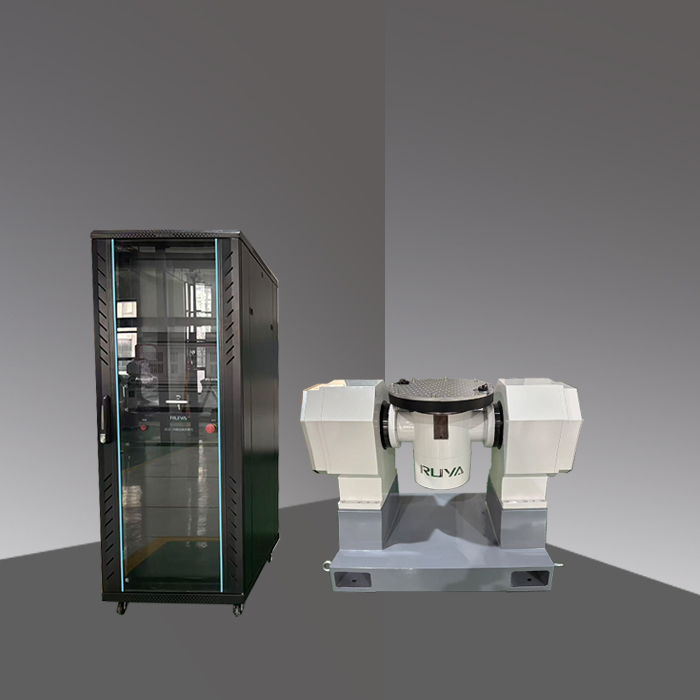
1. Analysis of Core Performance Dimensions: Accuracy, Stability, and Dynamic Response
Choosing a dual axis testing turntable is essentially a process of accurately matching its core performance indicators with its own application requirements. These indicators are interrelated and together determine the final testing capability of the turntable.
1.1 Precision System: Comprehensive Consideration from Static to Dynamic
Accuracy is the cornerstone of turntable performance and needs to be evaluated from both static and dynamic perspectives.
Static accuracy: mainly refers to position accuracy and repeatability accuracy. Position accuracy refers to the maximum deviation between the actual arrival position of the turntable and the commanded position, usually measured in arcseconds ("). For example, the spindle position accuracy of a certain model turntable is; ± 2 ", pitch axis is; ± 3 inches. The accuracy of repeated positioning is even more critical, as it measures the consistency of the turntable returning to the same position multiple times, directly affecting the reliability of the test. High performance turntables can reach within 1 inch. These two indicators are crucial in static testing and calibration.
Dynamic accuracy: refers to the accuracy performance of the turntable in continuous motion, with the core indicator being rate stability. It represents the degree of fluctuation in the actual output rate of the turntable under a constant rate command, usually measured by relative error (e.g.); 5×10?? )To measure. Stability at low rates (such as ); 0.001 °/s is particularly crucial for simulating extremely slow motion or conducting high-resolution testing.
1.2 Stability: the fundamental guarantee for long-term reliable operation
Stability determines the performance retention ability of the turntable in long-term operation or complex environments, which relies on precise mechanical design and thermal management.
Mechanical stability: The core lies in the shaft system structure. The mainstream high-precision turntable adopts; The "U-T" structure (with a U-shaped outer frame and a T-shaped inner frame) has the advantages of high stiffness, good axis orthogonality, and strong load adaptability. Next is the bearing capacity, which must be selected based on the maximum weight and size of the tested load (such as the common range of table diameter from Φ 320mm to Φ 600mm), and sufficient safety margin must be reserved.
Thermal stability and anti-interference: Temperature changes can cause thermal expansion of mechanical structures, introducing errors. For high demand applications, it is necessary to consider the thermal control design of the turntable or choose a model with an integrated temperature control box to provide a stable testing environment for the load. In addition, the anti vibration capability of the equipment is also an important part of environmental stability.
1.3 Dynamic response: the key to characterizing motion control capability
The dynamic response index measures the ability of the turntable to execute fast and complex motion instructions.
Range of speed and acceleration: The maximum angular velocity and maximum angular acceleration define the motion limits of the turntable. For example, the maximum speed of some turntables can reach; ±500°/s To ± 800 °/s, maximum acceleration can reach; 200°/s2 To 360 °/s2. When selecting, ensure that it covers the maximum motion envelope required by the test outline.
Dynamic response characteristics: Refers to the speed and accuracy of the turntable following control instructions, involving the bandwidth and response time of the servo control system. For testing scenarios that require simulation of rapid maneuvering or angular vibration (sway), high dynamic response capability is essential.
For comparison purposes, the following table summarizes the core performance parameter ranges of typical dual axis test turntables:
Table 1: Typical Range of Core Performance Parameters for Dual Axis Test Turntable
performance category | key parameters | Typical range/indicators | Explanation and Application Impact |
precision | position accuracy | ±1.0″ ~ ±30″ | The smaller the value, the higher the accuracy, which determines the static positioning accuracy. |
Repetitive positioning accuracy | ≤1.0″ | Affects the consistency of multiple test results. | |
Rate stationarity | 1×10?? ~ 1×10? 3 (360 ° average) | The smaller the value, the smaller the rate fluctuation and the higher the dynamic accuracy. | |
Minimum controllable rate | ±0.001°/s ~ ±0.01°/s | The ability to achieve extremely slow and precise control. | |
Stability and Load | maximum load | 5kg~200kg (customizable) | It must be greater than the total weight of the tested equipment and fixtures. |
Table diameter | Φ 320mm~Φ 800mm (customizable) | Need to adapt to the installation size of the load. | |
Axis structure | U-T type is the mainstream | Provide high stiffness and excellent shaft orthogonality. | |
dynamic response | Maximum angular velocity | ±50°/s ~ ± 20000 °/s (customizable) | Meet the requirements of high-speed rotation testing. |
Maximum angular acceleration | 10°/s2 ~ 8000 °/s2 (customizable) | Meet the requirements of fast start stop and maneuver testing. |
2. Selection process: from requirement definition to technical matching
Scientific selection should follow a systematic process to ensure that technical indicators serve practical applications.
1. Clarify testing requirements and standards: This is the starting point for selection. Firstly, it is necessary to define in detail the type of the tested object (gyroscope, inertial unit, guidance head, etc.), physical parameters (size, weight), testing purpose (calibration, functional testing, lifespan testing), and the testing standards or specifications that need to be followed. For example, in high standard fields such as aerospace, GJB 2426A-2015 "Testing Methods for Fiber Optic Gyroscopes"; It is a guiding document that provides unified regulations on the performance, environmental adaptability, and inspection methods of fiber optic gyroscopes. Clear standards are the foundation for all subsequent technical parameter negotiations and acceptance.
2. Quantitative core performance indicators: Based on the requirements of the first step, the precision, stability, and dynamic response requirements are concretized into numerical indicators. For example, if calibration of a certain type of fiber optic gyroscope is required, based on the testing requirements for its threshold and scale factor nonlinear error, it may be inferred that the turntable needs to be calibrated; 0.001°/s The minimum speed and; 1×10?? The stability of the speed.
3. Evaluate auxiliary systems and interfaces:
Slip ring: used to supply power and transmit signals to the load on the turntable, with a number of rings (such as 55 rings, 60 rings) that meets the requirements of all power and signal channels.
Control and software: Modern turntables are equipped with computer measurement and control systems, and their software should be evaluated for support of the required control modes (position, speed, swing), programming flexibility, data acquisition and analysis functions, and compatibility with existing testing systems for external interfaces (such as RS422).
4. Comprehensive trade-off and vendor research: Balancing cost, delivery cycle, after-sales service, and technical support capabilities while meeting core indicators. Priority should be given to manufacturers with rich case studies and good reputation in the target application field (such as inertial navigation testing).
3. Key selection points guided by application scenarios
Different testing applications have varying emphasis on the three core performance aspects.
Inertial device calibration and testing: This is the most classic application of dual axis turntables. Accuracy (especially rate stability and low rate performance) is the primary consideration, as key parameters such as gyroscope threshold, scale factor linearity, etc. are extremely sensitive to the accuracy of the input benchmark. Simultaneously, good positional accuracy is required for multi-point positioning testing.
Inertial Navigation System Simulation and Testing: Focusing on Dynamic Response and Range of Motion. The turntable needs to be able to simulate various angular movements of the aircraft or carrier (high-speed turning, maneuvering), therefore requiring high maximum angular velocity and acceleration. Meanwhile, the multi axis position combination capability is also used to simulate complex attitude changes.
Testing of photoelectric tracking equipment: Balancing dynamic response and low-speed stability. We need a turntable to simulate smooth visual axis scanning motion (requiring high flatness stability) and fast target capture and tracking (requiring high dynamic response).
Testing with environmental testing: If calibration and testing are required to be conducted under different temperature conditions, a turntable model that can be well integrated with the temperature control box structurally must be selected, or a dual axis turntable with an integrated temperature control box can be directly selected to ensure the reliability of the testing benchmark under temperature change conditions.
4. System Integration and Future Considerations
Choosing a turntable is not only about selecting an independent device, but also about planning a testing subsystem. The integration convenience with existing laboratory environment (foundation, vibration isolation), data acquisition system, and control software should be considered. Meanwhile, as testing tasks become increasingly complex, attention can be paid to whether the turntable has the potential for modular expansion (such as upgrading to three-axis in the future) and intelligent functions (such as model-based adaptive control and predictive maintenance support).
Choose a dual axis testing turntable according to standard specifications (such as GJB 5878-2006); General specifications for dual axis testing turntable GJB 1801-1993 The main performance testing methods for inertial technology testing equipment are system engineering based on accuracy, stability, and dynamic response. Only by transforming clear application requirements into specific technical indicators through scientific processes and accurately matching them with reliable products, can we ultimately invest in a testing tool that can serve scientific research and production tasks in a long-term, stable, and precise manner.