 0792-88989898
  ruya9898@163.com






How to choose a three-axis inertial turntable: Core selection guide for angular velocity, acceleration, and swing angle range!
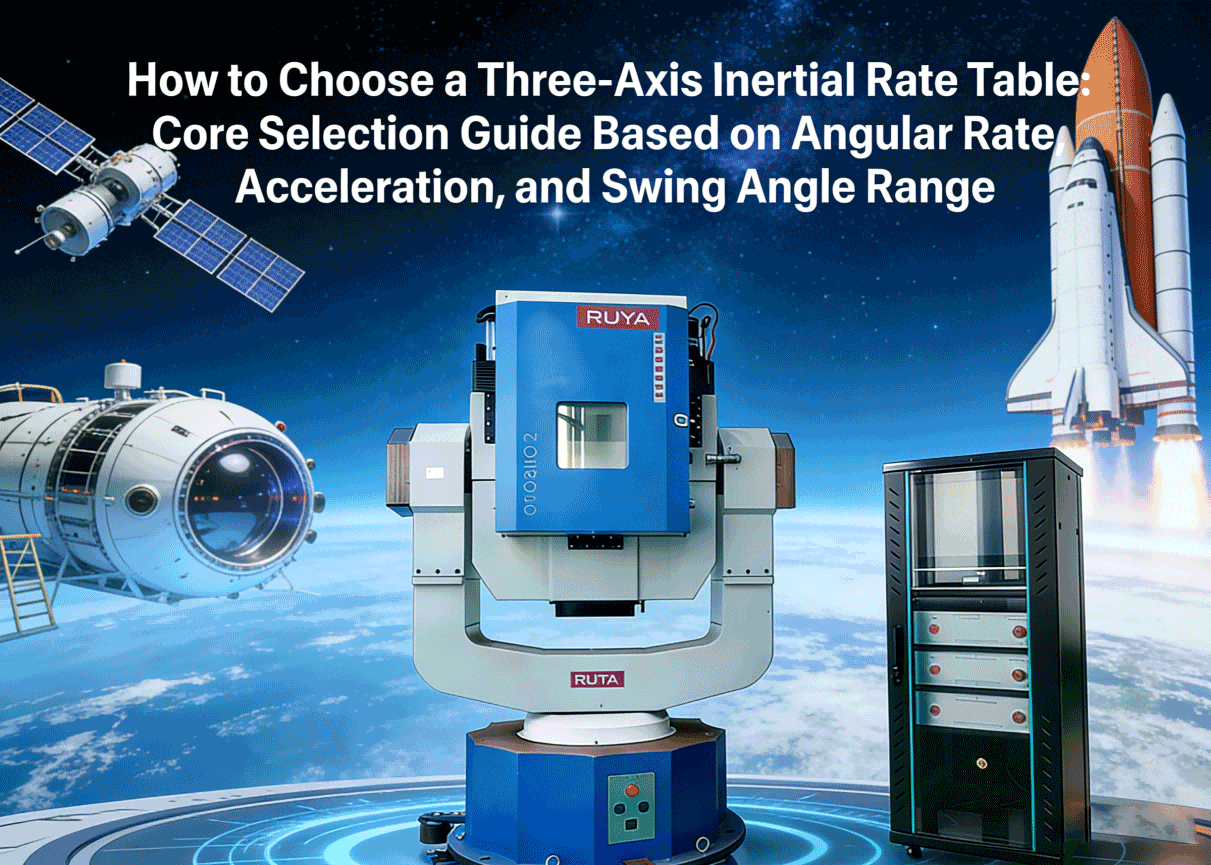
The three-axis inertial turntable is a key equipment for the development, testing, and calibration of core components such as inertial navigation systems (INS), gyroscopes, and inertial measurement units (IMU). Its performance directly determines the testing accuracy and reliability of inertial components, and is widely used in high-end fields such as aerospace, military equipment, and precision manufacturing. Among the numerous performance parameters of the three-axis inertial turntable, angular velocity, acceleration, and swing angle range are the three core indicators that directly match the working characteristics and testing requirements of the tested device. When selecting, the misconception of "higher parameters are better" should be abandoned, and scientific matching should be carried out based on the specifications of the tested device, testing scenarios, and industry standards. Starting from the core definitions, selection logic, influencing factors, and practical suggestions of the three major parameters, this article will provide professional and practical selection guidelines for industry practitioners, eliminate redundant hydrology, and focus on the key points of core selection.

1、 Selection premise: Clarify core requirements,Anchor selection criteria
The core logic of selection is "requirement matching" rather than parameter stacking. Before discussing the three core parameters, two basic premises need to be clarified to avoid selection bias: first, clarify the core technical parameters of the tested component, including the angular rate range, acceleration range, and working attitude range of the tested gyroscope/IMU, which are the core basis for selection; The second is to clarify the testing scenarios and distinguish between different scenarios such as static calibration, dynamic simulation, and extreme performance testing. For example, semi physical simulation in the aerospace field requires higher dynamic performance, while ordinary industrial IMU calibration focuses on accuracy and stability. At the same time, relevant industry standards such as military standard GJB 2884-97 "General Specification for Triaxial Angular Motion Simulation Turntable" should be followed to ensure that the selection meets the testing compliance requirements.
IIAngular velocityMatch the dynamic response of the tested component,Balance accuracy and range
(1) Core Definition and Selection Core
Angular velocity refers to the rotation angle of each axis of the turntable per unit time, measured in degrees per second. It is divided into three key indicators: velocity range, velocity accuracy, and velocity stability. The core selection principle is to "cover the maximum angular velocity requirement of the tested component, while considering testing accuracy and equipment cost". The angular velocities of the inner, middle, and outer frames of a three-axis turntable usually differ, with the inner frame having the largest velocity range and the outer frame having the smallest. They need to be matched according to the installation position of the tested component and the testing requirements.
(2) Key selection points
1. Range selection: It is necessary to meet the requirement of "maximum angular velocity of the tested object x safety factor (1.2-1.5)", which not only avoids the inability to complete the limit test due to insufficient range, but also prevents the waste of indicators and cost increase caused by excessive range. For example, if the maximum angular velocity of the tested MEMS gyroscope is ± 200 °/s, the angular velocity range of the corresponding axis of the turntable should be selected from ± 240 °/s to ± 300 °/s. If it is used for unmanned aerial vehicle inertial navigation testing and the maximum angular velocity of the tested component can reach 800 °/s, a turntable with a range of not less than ± 1000 °/s (safety factor 1.25) should be selected. In practical applications, the speed range of high-precision three-axis simulation turntables is usually 0.001 °/s~400 °/s for the inner frame, 0.001 °/s~300 °/s for the middle frame, and 0.001 °/s~200 °/s for the outer frame, which can cover the testing needs of most aerospace and industrial fields.
2. Accuracy and stationarity: Rate accuracy directly affects the calibration accuracy of the measured component, usually expressed as relative error. The accuracy requirements vary in different rate intervals. For example, when ω ≤ 1 °/s, the accuracy needs to reach 2 × 10⁻³ (1 ° average method), and when ω ≥ 10 °/s, the accuracy needs to reach 2 × 10 ⁻⁵ (360 ° average method). The stability of the signal during dynamic testing is determined by the stability of the rate, which needs to be adjusted according to the sensitivity of the tested object. For example, for high-precision fiber optic gyroscope testing, a turntable with a rate stability of ≤ 2 × 10 ⁻⁵ should be selected to avoid testing errors caused by rate fluctuations.
3. Special scenario considerations: During low-speed testing (such as 0.001 °/s~0.1 °/s), attention should be paid to the low-speed stability of the turntable to avoid "crawling phenomenon"; High speed testing (such as ≥ 300 °/s) requires attention to the stability and heat dissipation performance of the turntable's drive system to prevent vibration, heating, and other issues that may affect testing accuracy during high-speed operation. In addition, the resolution of the angular velocity also needs to match the requirements of the measured object. Generally, the resolution of the turntable velocity is required to be no less than 1/10 of the resolution of the measured object's angular velocity. For example, if the resolution of the measured object's angular velocity is 0.001 °/s, the resolution of the turntable velocity needs to reach 0.0001 °/s or above.
3、 Acceleration: Adapt to dynamic simulation requirements,Balancing response speed and load capacity
(1) Core Definition and Selection Core
Angular acceleration refers to the rate of change in the angular velocity of each axis of the turntable, measured in °/s ², reflecting the dynamic response capability of the turntable. The core selection principle is to "match the angular acceleration range of the measured component, taking into account the load capacity and response speed of the turntable". The angular acceleration directly determines whether the turntable can simulate the sudden change in attitude of the tested object in actual work, such as aircraft takeoff, turning, emergency braking, etc. Its performance is closely related to the turntable's drive motor, transmission mechanism, and control system.
(2) Key selection points
1. Range selection: Consistent with the logic of angular velocity range selection, it must meet the requirement of "maximum angular acceleration of the tested component multiplied by safety factor (1.2-1.5)". The angular acceleration requirements of different tested components vary greatly. For example, the maximum angular acceleration of a typical industrial IMU is ± 500 °/s ², while the maximum angular acceleration of a gyroscope in the aerospace field can reach ± 2000 °/s ² or more. The corresponding turntable needs to choose an angular acceleration range of ± 600 °/s ² to ± 3000 °/s ². In actual products, the maximum angular acceleration of high-precision three-axis simulation turntables is usually ± 2500 °/s ² for the inner frame, ± 2000 °/s ² for the middle frame, and ± 1500 °/s ² for the outer frame, which can meet the dynamic testing requirements of high-end inertial navigation devices.
2. Response speed and linearity: The response speed of angular acceleration determines whether the turntable can quickly simulate attitude changes, and it needs to match the dynamic response time of the tested object. The shorter the response time, the more suitable it is for high-speed dynamic simulation testing. At the same time, the linearity of angular acceleration needs to meet the testing requirements, usually requiring a linearity of ≤± 0.1% FS to avoid nonlinear errors affecting the accuracy of test data. In addition, attention should be paid to the smoothness of the turntable's acceleration and deceleration to prevent impact during acceleration and deceleration, damage to the tested part, or introduction of testing errors.
3. Load and structural influence: The angular acceleration performance of the turntable is affected by the weight and size of the load. The larger the load, the lower the upper limit of angular acceleration. Therefore, when selecting, it is necessary to consider the weight and installation dimensions of the tested component to ensure that the turntable can still achieve the required angular acceleration range under rated load. For example, if the weight of the test piece (including the fixture) is 45Kg, a turntable with a rated load of not less than 45Kg and the ability to achieve the target angular acceleration under this load should be selected. At the same time, the three-axis intersection degree of the turntable (usually requiring R0.5mm inside the ball) and the verticality of the shaft system should be considered to avoid load installation deviation affecting the angular acceleration performance.
4、 Swing angle range: covering the working posture of the tested object,Adapt to installation and testing scenarios
(1) Core Definition and Selection Core
The swing angle range (turning angle range) refers to the maximum angle range that each axis of the turntable can rotate, which is divided into two forms: continuous rotation and limited angle. The core selection principle is to "cover the entire working posture of the tested part, taking into account installation space and testing convenience". The three axes of the three-axis turntable (usually the rolling axis, pitch axis, and heading axis) have different swing angle ranges, and need to be selected separately according to the posture requirements of the measured part. At the same time, the problem of shaft interference needs to be considered to avoid posture limit conflicts when multiple axes are linked.
(2) Key selection points
1. Range selection: It is necessary to fully cover the actual working posture range of the tested object to avoid posture blind spots. For example, the pitch angle range of the unmanned aerial vehicle inertial navigation system is ± 90 °, the heading angle range is ± 180 °, and the rolling angle range is ± 360 °. The corresponding turntable needs to select a pitch axis of ± 90 °, a heading axis of ± 180 °, and a rolling axis of 360 ° for continuous rotation; If used for static calibration, the swing angle range can be appropriately reduced according to calibration requirements to reduce equipment costs. In practical applications, some three-axis turntables support continuous infinite rotation of three axes, which can be adapted to scenarios that require full attitude simulation, such as semi physical simulation testing of aircraft.
2. Axis interference and installation space: When selecting, attention should be paid to the structural form of the turntable (such as vertical UOO structure) to avoid angle interference during multi axis linkage, which may result in the inability to achieve the target posture. At the same time, it is necessary to ensure that the installation space of the turntable is sufficient based on the installation size of the tested part. For example, if the size of the tested part is 400mm × 400mm × 400mm, a turntable with a load installation space not less than this size should be selected to avoid limiting the swing angle range after installation. In addition, the swing angle accuracy also needs to match the testing requirements, usually requiring a swing angle accuracy of ≤± 0.001 ° and a repeatability accuracy of ≤± 0.0005 ° to ensure accurate attitude positioning.
3. Special scenario adaptation: For testing scenarios that require long-term continuous rotation (such as long-term stability testing of gyroscopes), a turntable that supports 360 ° continuous rotation and has self-locking function should be selected to avoid attitude deviation during rotation; For high-precision calibration scenarios, attention should be paid to the rotation accuracy of the turntable (usually requiring ± 0.001 °~± 0.002 °) to ensure the accuracy of the swing angle positioning. At the same time, a turntable equipped with an absolute encoder can be selected, which does not require re zeroing calibration after power failure, improving testing efficiency.
5、 Collaborative selection of three major parameters: avoiding misunderstandings,Realize optimal matching
Angular velocity, acceleration, and swing angle range are not independent selection methods, and they need to be coordinated and matched. At the same time, they should be combined with the characteristics of the tested object, testing scenarios, and cost budgets to avoid the following common selection errors:
1. Misconception 1: The higher the parameter, the better. Excessive parameters can lead to a significant increase in equipment costs and may result in performance waste. For example, ordinary industrial IMU testing does not require selecting a turntable with angular acceleration ≥ 2000 °/s ² and angular velocity ≥ 400 °/s. Choosing equipment that matches the parameters of the tested object can meet the requirements while reducing procurement and operation costs.
2. Misconception 2: Neglecting the coordinated performance of the shaft system. Partial selection only focuses on single axis parameters, ignoring the performance synergy when multiple axes are linked, resulting in issues such as attitude interference and decreased accuracy during the testing process. For example, the single axis angular velocity and acceleration of the turntable meet the requirements, but when multiple axes are linked, the outer frame angular velocity limits the inner frame acceleration, making it impossible to complete complex posture simulation.
3. Misconception 3: Neglecting environmental and standard requirements. In special testing environments such as high temperature, low temperature, and vacuum, the three major parameters of the turntable will be affected. When selecting, it is necessary to choose a dedicated turntable that is suitable for the environment; At the same time, it is necessary to strictly follow industry standards, such as military testing that must comply with standards such as GJB 2884-97 and GJB 1801-93, to ensure that test data is compliant and effective.
4. Misconception 4: Ignoring the impact of cross interference. The degree of orthogonality of the three axes of the turntable (cross axis sensitivity) will affect the testing accuracy of the three major parameters. Ideally, the three axes should be completely orthogonal. In actual selection, attention should be paid to the cross axis sensitivity index (usually ≤ 1%) to avoid interference from the motion of one axis on the parameter measurement of other axes.
6、 Selection Summary and Practical Suggestions
The core of selecting a three-axis inertial turntable is "demand-oriented, parameter matching, and coordinated consideration". The selection of the three major parameters of angular velocity, acceleration, and swing angle range should revolve around the core indicators of the tested object and the testing scenario. Specific practical suggestions are as follows:
1. Preliminary research: Clarify the angular velocity, acceleration, and working posture range of the tested object, sort out the testing scenarios (static/dynamic, conventional/extreme, single axis/multi axis linkage), determine the safety factor and accuracy requirements, and consult relevant industry standards to clarify compliance requirements.
2. Parameter matching: Based on the principle of "maximum parameter of the tested part x 1.2~1.5", the range of the three major parameters is preliminarily determined. Then, combined with details such as accuracy, response speed, and load capacity, suitable turntable models are selected, with a focus on the parameter differences between the inner, middle, and outer frames to ensure compatibility with the installation position of the tested part.
3. Performance verification: Before selecting, the manufacturer is required to provide parameter testing reports to verify the speed accuracy, angular acceleration linearity, swing angle accuracy, and other indicators of the turntable. If necessary, on-site testing should be conducted to ensure that the parameters meet the standards; At the same time, check the performance of the drive system, control system, conductive slip ring and other components of the turntable to ensure long-term stable operation.
4. Cost control: prioritize selecting equipment with parameter matching and stable performance while meeting testing requirements, to avoid blindly pursuing high parameters and wasting costs; At the same time, considering the maintenance and calibration costs of the equipment, choose manufacturers with comprehensive after-sales service and compliance with industry standards to ensure long-term reliable operation of the equipment.
In short, the selection of a three-axis inertial turntable is a systematic project, and the matching of angular velocity, acceleration, and swing angle range directly determines the efficiency and accuracy of the testing work. Only by meeting the needs of the tested components, following industry standards, and balancing performance and cost, can the most suitable equipment be selected to provide reliable support for the research, testing, and calibration of inertial devices.